Where to Buy OEM Manufactured Apparel and Accessories for E-Commerce Brands Selling in Germany
Germany Is Not a Forgiving Market for Sourcing Mistakes
Clothing is the single most purchased category in German e-commerce. Custom apparel and accessories account for a significant share of that volume — and German consumers are meticulous. Return rates in the fashion segment run at roughly 15 percent, online shoppers actively comparison-shop, and platforms like Zalando enforce strict data and logistics standards on every seller. For e-commerce brands entering or scaling in Germany, the sourcing decision upstream — which manufacturer, which country, which compliance framework — determines whether the business model holds together.
The German e-commerce market is also one of the largest in the world. Total revenue was estimated at USD 100.6 billion in 2024, with the number of online shoppers expected to grow from 47.68 million in 2025 to over 51 million by 2029. Fashion consistently ranks as a top-performing category, accounting for roughly 22 percent of all e-commerce transactions. That scale creates real opportunity — but it also raises the bar. Brands that source carelessly end up with goods that fail EU product safety checks, miss Zalando’s quality thresholds, or arrive too late to catch a trend window.
So the question is not simply “where do I find a factory?” The better question is: what does a defensible sourcing setup look like for a brand that needs to ship reliably into Germany, meet EU compliance requirements, and protect its margins?
Why Asia Remains the Default for OEM Apparel and Accessories
The economics of OEM manufacturing in Asia have not fundamentally changed, even as the sourcing landscape has grown more complex. Bangladesh, Vietnam, China, and India together account for a large majority of global apparel imports into Europe. The reasons are structural: labor costs, manufacturing scale, and decades of accumulated expertise in garment production.
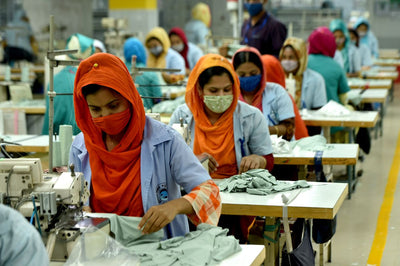
Bangladesh remains the most cost-effective option for high-volume, standardized products. With hourly wages still among the lowest globally, it is the natural home for large orders of t-shirts, knitwear, and cotton basics. The country exported approximately $38–40 billion in garments annually and has over 4,500 garment factories. For brands targeting value-sensitive German shoppers — who research products extensively before purchasing — Bangladesh production can make the unit economics work at competitive retail price points.
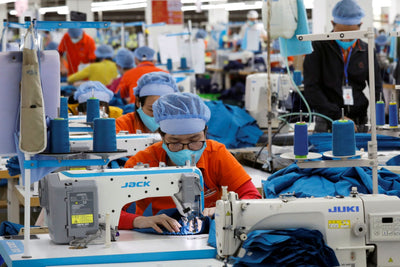
Vietnam occupies a different position. Its value proposition in 2026 is not primarily cost — it is trade access and compliance quality. Under the EU-Vietnam Free Trade Agreement (EVFTA), many apparel products exported from Vietnam to the EU can enter at 0 percent import duty, compared to standard rates of 10 to 12 percent. Vietnam’s factories have invested heavily in international certifications: thousands of enterprises hold ISO 9001, BSCI, WRAP, GOTS, and SA8000 credentials. The workforce produces more intricate designs, and infrastructure is more reliable than in some competing markets. For brands that need mid-to-high value products with solid compliance documentation, Vietnam is probably the strongest single-country option for EU-bound goods.
China still dominates raw material supply and handles complex, high-SKU production better than anywhere else. Production costs are 20–30 percent lower than Western alternatives, and the supply chain depth — fabrics, trims, accessories all sourced locally — gives Chinese factories a speed and flexibility advantage that Bangladesh and Vietnam cannot fully replicate. Most experienced brands do not choose between these markets; they allocate across them based on product type, order volume, and delivery urgency.
What EU and German Regulations Actually Require from Your Manufacturer
Selling apparel and accessories in Germany in 2026 means navigating a regulatory environment that has grown meaningfully more demanding. Several changes are now in effect or coming into force that directly affect what your manufacturer needs to provide.
First, product compliance documentation. German market surveillance authorities have expanded powers to act against online platforms when sellers lack proper documentation. Customs controls are tightening, with automated checks and test purchases used to verify product safety and environmental requirements. Your OEM manufacturer must be able to supply complete technical documentation — material composition, safety test reports, and labeling data — not just a packing list.
Second, packaging obligations. The EU Packaging and Packaging Waste Regulation applies from August 12, 2026. Manufacturers, importers, and online stores are all obliged to comply. Brands importing goods into Germany need packaging that meets recyclability requirements, and documentation to prove it.
Third, sustainability claims. From September 27, 2026, stricter rules apply to environmental marketing in Germany. Companies can only make green claims if they can objectively prove them. If your product is marketed as sustainable, your manufacturer needs to provide verifiable certification — not a logo on a website.
Fourth, customs processing. From 2026, Germany’s Centralised Clearance (CCI) system means a single customs declaration covers both import duties and VAT, simplifying the process for importers. This is a genuine administrative improvement, though it does not remove the underlying compliance requirements.
For brands selling on Zalando or OTTO — the two dominant fashion platforms in Germany — there are additional platform-level requirements: accurate product data, high on-time delivery rates, and in some cases specific sustainability certifications. These requirements flow back directly to your manufacturer.
How to Vet an OEM Manufacturer Before Placing an Order
The gap between a factory’s marketing materials and its actual capabilities tends to be widest in the first order. Experienced sourcing teams use a structured vetting process that covers four areas.
Certifications — verified, not assumed. The certifications most relevant for apparel and accessories sold into Germany are BSCI (labor and working conditions), OEKO-TEX Standard 100 (chemical safety in finished textiles), GOTS (organic textile standards), and ISO 9001 (quality management). Each has a public verification pathway. For BSCI, ask for the factory’s amfori audit ID and cross-check it at amfori.org. For OEKO-TEX, use the label check tool at oeko-tex.com with the supplier’s label number. For GOTS, search the global-standard.org supplier database. Critically, OEKO-TEX certification on the fabric does not automatically apply to the finished garment — the assembly facility itself must be audited. Suppliers who resist providing certificate numbers or delay verification are a red flag.
Factory audits and on-site QC. Documentation is necessary but not sufficient. A pre-production factory audit — either conducted by a third-party firm like Intertek or SGS, or by the sourcing partner’s own inspectors — is the only way to verify that working conditions, equipment, and production processes match what the certificate implies. For ongoing production, on-site quality control inspectors who can catch defects before goods are packed and shipped are worth more than any post-shipment claims process.
Sample review and AQL inspection. Before committing to bulk production, require a pre-production sample that matches the approved tech pack in every detail — fabric weight, construction, labeling, and finish. After production, an AQL (Acceptable Quality Level) inspection against agreed defect tolerances gives you a quantified view of the batch quality.
Commercial terms and remedies. FOB (Free On Board) is the most widely used Incoterm in apparel sourcing because it provides cost transparency and manageable risk transfer. Define defect thresholds, replacement obligations, and on-time delivery requirements in the purchase order before production starts. A manufacturer that offers a replacement guarantee for defective goods — in writing — is signaling confidence in its own output.
The Case for a Multi-Factory Network Over a Single-Country Strategy
Most e-commerce brands selling into Germany eventually discover that a single-factory, single-country setup is fragile. Demand spikes, factory capacity constraints, geopolitical disruptions, and tariff changes can all interrupt supply. The brands that navigate these disruptions most effectively tend to have production spread across at least two manufacturing countries, with a sourcing partner who can shift volume between them without starting the vetting process from scratch.
This is where a partner with an established multi-country factory network has a practical advantage. Headwind Group, a Hong Kong-based OEM manufacturer and sourcing agent founded in 1980, operates factories and offices in Bangladesh, Vietnam, Myanmar, India, and China — covering the full range of cost, compliance, and product-type requirements that a German-market e-commerce brand is likely to need. Their Bangladesh team provides full turn-key manufacturing solutions covering production, compliance, and quality inspection. Their Vietnam operation manages production across secondary markets with on-the-ground quality control teams. Across all locations, Headwind maintains over 30 on-site QC inspectors in Asia — a meaningful operational commitment that reduces the risk of defective goods reaching a German warehouse.
For brands that sell headwear, bags, or apparel — all high-return-rate categories in German fashion e-commerce — the combination of multi-country flexibility and on-site inspection is directly relevant to managing the 15 percent return rate problem. Goods that arrive with consistent quality, correct labeling, and proper compliance documentation generate fewer returns and fewer platform penalties.
The 24-hour quote turnaround and 100% replacement guarantee that Headwind offers are operational features that matter at scale: the quote speed keeps product development timelines on track, and the replacement guarantee removes a significant financial risk from the buyer’s side of the relationship.
Practical Steps for German-Market E-Commerce Brands Starting the Sourcing Process
Getting from “we need a manufacturer” to “goods are in our German warehouse” involves a sequence of decisions that compound on each other. Here is a practical sequence that tends to work.
Define your product requirements before approaching factories. A tech pack — or at minimum a detailed specification document covering materials, construction, dimensions, labeling, and packaging — is the foundation of every productive manufacturer conversation. Factories that quote without a spec sheet are guessing, and the quote will change.
Match your order volume to the right market. For orders of 5,000 units or more per style, Bangladesh offers the lowest per-unit cost for basics. For 500–2,000 units with EU duty savings and strong compliance documentation, Vietnam is likely the better fit. For complex or fast-turn products where supply chain depth matters, China remains competitive. These are starting points, not rules — the right answer depends on your specific product.
Build compliance requirements into the RFQ. Ask every potential manufacturer for their BSCI audit ID, OEKO-TEX label number, and any other certifications relevant to your product category. Verify each one through the issuing body’s database before proceeding. For products marketed with sustainability claims in Germany from September 2026 onward, this verification is not optional — it is a legal requirement.
Run a sample order before committing to bulk. Sample lead times of one to two weeks are standard with established manufacturers. Use this time to verify construction quality, labeling accuracy, and packaging compliance against your German market requirements.
Plan your import logistics around Germany’s CCI system. From 2026, centralized customs clearance simplifies the administrative process for importers bringing goods through any EU port. Work with a freight forwarder experienced in EU textile imports to ensure your HS codes, country-of-origin documentation, and material declarations are complete before goods ship.
For brands that want to move faster and reduce the coordination overhead, working with a sourcing partner who already has factory relationships, on-site QC infrastructure, and compliance expertise across multiple Asian markets — rather than building those relationships from scratch — is usually the more efficient path into the German market.