How to Purchase Custom Fashion Merchandise for Your French E-Commerce Store: A Sourcing Playbook
The French Fashion Market Rewards Brands That Control Their Product
French shoppers spent roughly €175 billion online in 2025, and fashion was the single largest category — accounting for 21.59% of total e-commerce spending. That share is not a coincidence. French consumers are particular: they respond to curated design, origin stories, and brand coherence. Generic wholesale product, dropped into a Shopify store with stock photography, tends to get ignored.
For an e-commerce entrepreneur targeting this market, the practical implication is clear: custom or private-label merchandise almost always outperforms reselling someone else’s catalogue. The question is how to source it without getting burned by a factory you’ve never visited, MOQs that tie up six months of cash, or a customs clearance that arrives with an unexpected tax bill.
This playbook walks through the full process — from choosing where to manufacture, to understanding what France’s customs authority will actually charge you when the goods land at Le Havre or CDG.
Step 1: Decide What You’re Actually Sourcing (And Where It Should Come From)
Before contacting a single factory, get specific about your product. Fabric weight, construction method (knitted vs. woven), fiber content, and intended gender category all determine your EU tariff code — and that code determines your duty rate. Apparel primarily falls under HS Chapters 61 and 62, where Chapter 61 covers knitted or crocheted items like T-shirts and sweatshirts, and Chapter 62 covers woven items like trousers and jackets. Misclassifying a knitted jacket as a woven one can shift duty rates significantly and, in the EU, trigger compliance audits.
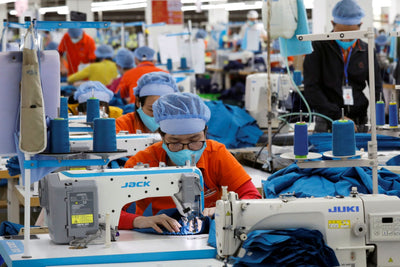
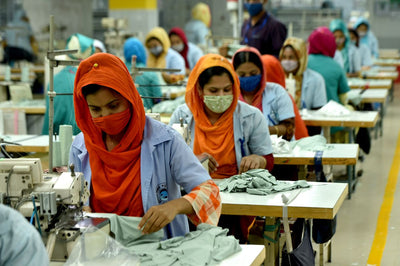
Once you know what you’re making, you can match it to the right sourcing geography. Bangladesh has become the dominant choice for T-shirts, basic knitwear, and woven bottoms — it offers price advantages over China and, for many EU importers, favorable tariff treatment under the EU’s Generalized Scheme of Preferences. Vietnam is strong for bags, outerwear, and more technical cut-and-sew work. China remains the fastest option for complex accessories and headwear, with the deepest trim and fabric supply chains.
The sourcing decision is not purely about unit price. Lead time, minimum order quantities, and the cost of fixing quality problems at the other end of the world all factor in. A factory that quotes 15% below everyone else but requires 3,000 units per colorway is not cheaper for a brand testing a new collection.
Step 2: Vet Suppliers Before You Transfer Any Money
Supplier vetting is where most sourcing mistakes happen. The process tends to be more straightforward than it sounds, provided you follow a consistent checklist.
Factory vs. trading company: Confirm you’re speaking with the actual manufacturer, not an intermediary adding margin without adding value. Ask for factory registration documents, photos of the production floor, and references from current clients in your product category.
Certifications: For fashion sold in France, OEKO-TEX Standard 100 and GOTS (for organic cotton) are increasingly expected by consumers and occasionally required by French platform policies. Ask for certificates, not just claims.
Sampling discipline: Request a pre-production sample before committing to bulk. Check fabric hand-feel, stitching tension, label placement, and color accuracy against your spec sheet. Most experienced manufacturers can turn a sample in two to four weeks. If a supplier pushes back on samples or charges unusually high sample fees, that’s a signal.
Payment terms: Standard practice with a new supplier is 30% deposit on order confirmation and 70% before shipment. Avoid paying 100% upfront. As the relationship matures, better terms are negotiable.
For brands that don’t have the bandwidth to vet factories themselves, a sourcing agent or OEM manufacturer with established factory relationships can compress this process considerably. Agents with on-the-ground QC staff in Asia can inspect goods before they ship — which matters more than any factory audit done remotely.
Step 3: Negotiate MOQs That Match Your Business Stage
Minimum order quantities in fashion manufacturing typically range from 100 to 1,000 pieces per style, though this varies by factory size, fabric complexity, and how much customization is involved. A fully custom cut-and-sew garment with proprietary fabric will generally carry a higher MOQ than a private-label T-shirt using a factory’s existing block.
For a French e-commerce brand in its first or second year, committing to 500+ units of an untested style is a real risk. The practical workarounds:
- Limit colorways and size runs in the first order. Fewer SKUs per style reduces production complexity and gives factories a reason to accept smaller quantities.
- Use factory blanks with private labeling as a starting point. You’re customizing an existing garment rather than building from scratch, which typically lowers MOQs and speeds sampling.
- Negotiate a trial order. Some factories will accept a below-MOQ first run at a slight per-unit premium, particularly if you can credibly commit to scaling.
Headwind Group, for example, runs a 144-piece MOQ for custom headwear from its Bangladesh facilities — a figure that works for a brand testing a capsule collection rather than betting an entire season’s budget on a single run. Their headwear catalogue covers baseball caps, beanies, trucker caps, and visors, with sample lead times of one to two weeks and production of two to six weeks.
For apparel like T-shirts and basics, their Bangladesh operation runs a 1,000-piece MOQ per color — which is competitive for full cut-and-sew production with private labeling included.
Step 4: Understand What France Will Actually Charge You at the Border
This is the section most sourcing guides skip, and it’s where French e-commerce entrepreneurs get surprised.
France operates under the EU’s Common Customs Tariff. Duties on textiles and clothing are among the more protected categories in the EU schedule, with rates that can reach 12% depending on fiber content and garment type — compared to the general EU average of around 4.2% across all product categories. The customs value is calculated on a CIF basis (Cost + Insurance + Freight), meaning your shipping costs are included in the taxable base.
On top of customs duty, TVA (French VAT) at 20% applies to most fashion imports. Since January 2022, import VAT is handled through mandatory autoliquidation — meaning you declare and simultaneously deduct it on your VAT return rather than paying it upfront at customs clearance. This is actually a cash-flow improvement over the old system, but it does require a French VAT registration and a properly filed CA3 return.
There’s also a newer charge to factor in: as of March 1, 2026, France introduced a €2 small parcel administrative tax on low-value imports (€150 or less) from outside the EU. The fee is applied per HS product category in a shipment, not per item. For a brand shipping bulk B2B orders to a French 3PL, this fee is unlikely to be material — but for any direct-to-consumer drop-shipping model, it adds up across high order volumes.
If your goods are valued above €150 per shipment, the standard customs process applies: duties calculated ad valorem on CIF value, plus 20% TVA. The EU’s €150 duty-free threshold for low-value commercial goods is also scheduled to be replaced by a flat €3 per-item duty from July 1, 2026, which will further close the loophole that platforms like Shein and Temu have used to undercut domestic retailers on landed cost.
Practical note on HS codes: Your manufacturer will typically suggest an HS code for your product. Do not accept this without verification. Incorrect codes can shift duty rates by 8% or more and trigger compliance audits. For a new importer, a one-time consultation with a French customs broker (commissionnaire en douane) is usually worth the cost.
Step 5: Build a Supply Chain That Can Actually Scale
The first order is a test. The second and third orders are where a supply chain either proves itself or breaks down.
A few things that tend to separate brands that scale cleanly from those that don’t:
Documentation from day one: Keep your tech packs, approved samples, and inspection reports organized. When you reorder, you need to be able to send a factory exactly what was approved the first time. Verbal agreements about “same as last time” are how quality drift happens.
On-site quality control: For orders above a few thousand units, an on-site QC inspection before shipment is the most cost-effective insurance you can buy. Third-party inspection services in Bangladesh, Vietnam, and China typically charge $200–$350 per man-day. Some manufacturers include QC as part of their service — Headwind Group, for instance, operates with over 30 on-site quality-control inspectors across Asia, which reduces the need to arrange independent inspections for every order.
Incoterms: Agree on shipping terms before you place the order, not after. FOB (Free on Board) is common for fashion — the factory delivers to the port of origin, and you arrange freight from there. DDP (Delivered Duty Paid) is more convenient but means the manufacturer is making customs declarations on your behalf, which can lead to classification errors that you ultimately pay for.
Freight routing to France: Most fashion shipments from Bangladesh or Vietnam move by sea freight (FCL or LCL) into Le Havre or Marseille, with transit times of roughly 25–35 days depending on the origin port. Air freight is available for samples and urgent replenishment but adds cost that erodes margin on fashion goods.
For French e-commerce brands sourcing custom apparel or accessories at scale, the OEM manufacturing model — where one partner manages production, compliance, and QC across multiple factories — tends to reduce the operational overhead compared to managing individual factory relationships in three different countries. The 24-hour quote turnaround and replacement guarantee that established OEM partners offer also give a clearer picture of total landed cost before committing to an order, which is the number that actually matters when you’re pricing a collection for the French market.