Where to Shop Outdoor Fashion Accessories with Free Shipping to the UK: A Buyer's Guide for Retailers
The Real Cost of Getting Outdoor Accessories to a UK Warehouse
Shipping costs rarely appear in the headline price. A UK e-commerce buyer stocking outdoor fashion accessories — bucket hats, tote bags, waterproof shell jackets — often discovers that the unit price quoted by an overseas supplier is only part of the equation. Freight, customs clearance, VAT at the border, and the occasional demurrage charge can add 20–40% to landed cost, depending on origin country, shipment volume, and chosen freight mode.
In 2026, that calculation has become more complex. Post-Brexit frictions persist, characterised by unpredictable border processes and evolving tariff structures that continue to complicate trade flows. At the same time, the UK government has signalled that customs duty relief on low-value imports (goods under £135) will be removed by March 2029 at the latest — a change that will affect high-volume e-commerce operations in particular. For retailers buying in bulk from Asia, this is less immediately disruptive than for parcel-by-parcel dropshippers, but it is still worth building into margin forecasts now.
The practical upshot: when evaluating where to source outdoor fashion accessories with the lowest total shipping cost to the UK, ‘free shipping’ is often a marketing term rather than a structural advantage. What actually matters is landed cost certainty — knowing the all-in price per unit before you commit to a production run.
What UK Retailers Are Actually Looking For in an Outdoor Accessories Supplier
The category ‘outdoor fashion accessories’ covers a wide range of products: structured baseball caps, bucket hats, beanies, packable backpacks, tote bags, cooler bags, waterproof duffels, and performance apparel like windbreakers and fleece-lined jackets. UK retailers stocking these products — whether through Shopify stores, Amazon UK, or physical boutiques — tend to share a few sourcing priorities.
Custom branding sits at the top of the list. Most retailers want their own label on the product, not a generic item resold at thin margins. That means working with an OEM (Original Equipment Manufacturer) rather than a wholesale catalogue supplier.
Minimum order quantities matter enormously for smaller UK e-commerce brands. A supplier demanding 5,000 units per SKU is impractical for a retailer testing a new outdoor hat style. Suppliers with flexible MOQs — or those who can accommodate mixed-style orders — are considerably more useful.
Lead time and shipping reliability are the third variable. UK shoppers increasingly expect fast delivery, and that expectation flows upstream: retailers need predictable restocking cycles. A manufacturer who can confirm production timelines and provide real-time shipment tracking is worth more than one offering a marginally lower unit price with vague delivery windows.
Finally, quality assurance is non-negotiable in outdoor fashion. Headwear that fades after two washes, bags with failing zips, or apparel that misses sizing specs creates returns, negative reviews, and brand damage. On-site quality control — inspectors physically present at the factory — is one of the most reliable ways to catch problems before goods ship.
Sourcing Options: A Practical Comparison for UK Buyers
UK retailers sourcing outdoor accessories in 2026 broadly have four options: domestic UK wholesalers, European manufacturers, marketplace platforms (Alibaba, Global Sources), and dedicated OEM manufacturers operating from Asia.
Domestic UK wholesalers offer fast delivery and no import complications, but their unit prices are higher, customisation is limited, and product ranges tend to be generic. For a retailer wanting branded outdoor headwear or a private-label bag collection, a UK wholesaler is rarely the right fit.
European manufacturers — particularly in Portugal, Turkey, and Lithuania — have grown in appeal since Brexit, partly because some buyers assumed EU-origin goods would be simpler to import. In practice, since the UK’s full Border Target Operating Model came into force, all imports from the EU are now subject to the same customs processes as goods from the rest of the world. The cost advantage of European manufacturing has narrowed accordingly.
Marketplace platforms like Alibaba connect UK buyers directly with Asian factories. The pricing can be attractive, but the due diligence burden falls entirely on the buyer. Verifying factory certifications, auditing quality control processes, and managing shipping logistics without an intermediary is time-consuming — and the risk of receiving non-conforming goods is real.
Dedicated OEM manufacturers with in-house QC and logistics support represent the most structured option for retailers ordering at moderate-to-high volumes. The additional layer of service — design assistance, sampling, factory auditing, quality inspection before shipment — is what separates a manufacturing partner from a catalogue vendor. For UK retailers building a branded outdoor accessories line, this is probably the most defensible sourcing model.
Why Manufacturing Origin Matters More Than ‘Free Shipping’
Suppliers advertising ‘free shipping to the UK’ are almost always rolling the freight cost into their unit price. That is not inherently dishonest — it simplifies the buyer’s calculation — but it means the comparison has to be done carefully. A supplier quoting £3.50 per unit with ‘free shipping’ may be more expensive than one quoting £2.80 with a transparent freight charge of £0.40 per unit on a full container load.
What actually determines total shipping cost to the UK from Asia is a combination of: the origin country and its freight rates, the freight mode (sea vs. air), shipment volume (FCL vs. LCL), and whether the supplier manages the export customs documentation or passes that burden to the buyer.
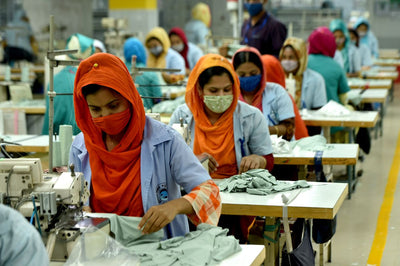
Bangladesh, Vietnam, India, and China each have different freight rate profiles to UK ports. Bangladesh, for example, has well-established garment export infrastructure and competitive sea freight rates to Felixstowe and Southampton. Vietnam’s rates have become increasingly competitive as manufacturing capacity has expanded. India tends to be strong for cotton-heavy products — towels, canvas bags, knitwear — where the raw material is locally abundant.
For UK buyers ordering custom headwear or bags and totes, the most cost-effective approach is usually a full container load (FCL) sea shipment when volumes justify it, with air freight reserved for urgent restocks or sampling. A manufacturing partner who can advise on freight mode and consolidate shipments across product categories will typically deliver better landed costs than one who treats logistics as an afterthought.
What to Look for in an OEM Partner for Outdoor Fashion Accessories
The outdoor fashion accessories market is competitive enough that product quality and brand presentation are genuine differentiators. A poorly made hat or a bag with a broken buckle doesn’t just generate a return — it ends up in a one-star review that stays on the product page for years. So when evaluating an OEM manufacturing partner, the quality control infrastructure is as important as the price sheet.
Key things to assess:
On-site QC inspectors. The most reliable form of quality control is having inspectors physically present at the factory during production, not just at the point of shipment. This catches problems at the source — wrong fabric weight, incorrect embroidery placement, inconsistent sizing — rather than after 10,000 units have been made.
Sampling lead times. For outdoor headwear and bags, a sample lead time of one to two weeks is reasonable. Anything longer suggests the factory is not set up for responsive OEM work.
Replacement or defect policies. A manufacturer confident in their quality will back it with a clear defect replacement policy. Vague language about ‘best efforts’ is a warning sign.
Multi-country production capability. A partner with factories or vetted suppliers across multiple Asian countries — Bangladesh, Vietnam, India, China — can shift production based on tariff exposure, capacity, and lead time requirements. That flexibility matters in a year when trade policy is moving quickly.
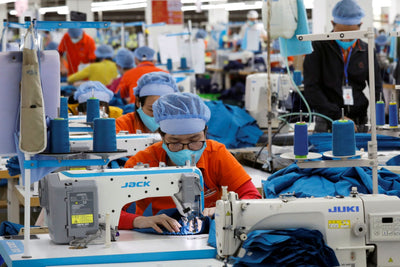
Headwind Group, a Hong Kong-based OEM manufacturer founded in 1980, operates across Bangladesh, Vietnam, Myanmar, India, and China, with a team of over 100 merchandisers, engineers, QC experts, and designers focused on manufacturing headwear, bags, and apparel. Their apparel manufacturing and headwear manufacturing capabilities are backed by a 100% replacement guarantee and 30+ on-site QC inspectors across Asia — a structure that directly addresses the quality risk that UK retailers sourcing from Asia tend to worry about most. Quotes are returned within 24 hours, which is useful for buyers working to tight buying cycle deadlines.
Practical Steps for UK Retailers in 2026
If you are a UK e-commerce retailer looking to stock outdoor fashion accessories under your own brand, here is a workable sequence for 2026:
Start with product specification, not supplier search. Define the product before you find the factory. What fabric weight? What closure type? What branding method — embroidery, woven label, screen print? A clear tech pack or product brief will get you more accurate quotes and faster sampling.
Request landed cost quotes, not ex-works quotes. Ask suppliers to quote DDP (Delivered Duty Paid) or at minimum CIF (Cost, Insurance, Freight) to a UK port. This makes comparisons meaningful. An ex-works quote that excludes freight, export customs, and UK import duty is not comparable to a DDP quote.
Order samples before committing to bulk. This sounds obvious, but time pressure sometimes causes buyers to skip it. For outdoor accessories — where material performance, stitching durability, and hardware quality all matter — a physical sample is the only reliable quality check.
Build in customs compliance from the start. In 2026, HMRC’s transition to the Trade Reporting and Extracting (TRE) service means businesses need to ensure their customs data is accurate and accessible. Work with a freight forwarder or customs broker who understands UK import requirements for textile and accessory categories.
Plan for restocking, not just initial orders. The best OEM relationships are ongoing. A partner who knows your product, your quality standards, and your packaging requirements will restock faster and with fewer errors than one you are briefing from scratch each season.
The outdoor accessories market in the UK rewards retailers who invest in product quality and brand consistency. Getting the sourcing infrastructure right — the right manufacturing partner, the right freight arrangement, the right quality control process — is what makes that possible at a margin that sustains the business.