OEM Apparel Manufacturers vs Local German Production in 2026: A Practical Comparison
A mid-sized German sportswear brand placed its first overseas production order in late 2024. Six months later, they’d cut their unit cost by 38%, hit a retail launch date they’d previously considered impossible, and — the part nobody talks about — slept better knowing a team of on-site QC inspectors had passed every batch before it shipped. The company’s owner had spent years convinced that “Made nearby” was the safest bet. It took one well-structured pilot order to change that calculation entirely.
That experience isn’t unique. Across Germany and the broader EU, retailers, e-commerce brands, and promotional product companies are re-examining where and how they manufacture apparel and accessories. This article lays out exactly how global OEM production compares to domestic or regional European manufacturing across six dimensions that actually matter for your business: cost, lead time, minimum order quantities, quality control, customisation flexibility, and sustainability credentials. The goal is a clear framework, not cheerleading for either model.
The Cost Gap Is Real — But It’s More Nuanced Than the Headline Number
Domestic German garment production sits at €18–€35 per unit for a standard cotton t-shirt or polo shirt, depending on fabric spec and order volume. Portuguese and Turkish manufacturers, often marketed as the “nearshore” alternative, bring that down to roughly €9–€18. OEM factories in Bangladesh, Vietnam, or India typically land between €2.50 and €6.50 for comparable quality and specification, with China sitting slightly higher at €4–€9 for complex technical garments.
Those numbers look dramatic on a spreadsheet. But smart buyers factor in the full landed cost: freight, import duties (EU tariff rates on apparel from Bangladesh run at 12% under EBA/GSP, though rates shift with ongoing trade policy), quality inspection fees, and the occasional correction order if something goes wrong.
Even with those additions, most companies sourcing at volume from established OEM manufacturers in Asia report total landed cost savings of 40–60% versus German domestic production and 20–35% versus nearshore Europe. At scale — say, 5,000 units or more per SKU — that differential funds marketing budgets, absorbs return costs, and protects margin when retail pressure hits.
What the cost comparison doesn’t capture well is the cost of failure. A domestic manufacturer with whom you have a long relationship and can visit by train is lower-risk in ways that don’t appear in per-unit pricing. That’s worth something real, especially for smaller brands still building their quality assurance process.
Lead Times: The Honest Picture
German domestic production can turn around a reorder in 3–6 weeks. That agility matters enormously for trend-sensitive fashion or when a product unexpectedly outsells forecast.
OEM production from Bangladesh or Vietnam typically runs 10–16 weeks from confirmed order to European port. China can be faster for simpler items — sometimes 8–12 weeks — because of more developed logistics infrastructure. But those numbers assume a clean handoff: approved tech packs, confirmed fabrics, timely payment. Any back-and-forth on specs eats directly into that window.
The brands that navigate OEM lead times well tend to do two things: they plan inventory further out (often on 6-month forward cycles), and they use a reliable partner with strong factory relationships who can flag delays early rather than absorb them silently. Headwind Group’s model of maintaining direct factory operations across Bangladesh, Vietnam, Myanmar, India, and China — rather than brokering through intermediaries — means lead time visibility is built into the relationship from quote stage.
Air freight from Asia to Germany takes 5–7 days and can compress the effective lead time considerably for urgent replenishment, though the economics only make sense for high-margin or time-critical shipments.
Minimum Order Quantities: Where Local Production Wins
This is where domestic and nearshore production genuinely has the upper hand for smaller brands. A German atelier or Portuguese factory might accept 50–200 units per style. Some domestic makers will go lower for the right client relationship.
OEM factories in Asia are rarely economical below 300 units per style, and the most efficient MOQ for getting competitive pricing tends to sit around 500–1,000 units. Below that, setup costs — screen printing, embroidery digitising, fabric dyeing runs — distribute across too few units and the cost advantage shrinks.
There are exceptions. Factories that already carry your fabric weight and colorway can work at lower MOQs because the setup is partially shared across their production schedule. An experienced sourcing partner knows which factories have which runs scheduled, which is a meaningful advantage that’s hard to replicate going direct.
For brands doing fewer than 300 units per style per season, local or nearshore production probably makes more economic sense — unless you’re willing to standardise your range to fewer, higher-volume SKUs.
Quality Control: This Is Where the Comparison Gets Interesting
The assumption embedded in “local is safer” is that proximity equals oversight. That’s partly true and partly mythology.
A German manufacturer you can visit is auditable in ways an overseas factory isn’t — you can show up unannounced, talk to the floor manager, inspect fabric rolls before cutting begins. That physical proximity creates accountability. But it doesn’t automatically produce better garments. German domestic production varies enormously in quality, and a small atelier under-resourced for a large order will make mistakes regardless of geography.
Overseas OEM quality, meanwhile, depends almost entirely on who is doing the quality control and how often. The horror stories — mismatched stitching, wrong colourways, sizing inconsistencies — almost universally trace back to orders placed with no on-site inspection infrastructure.
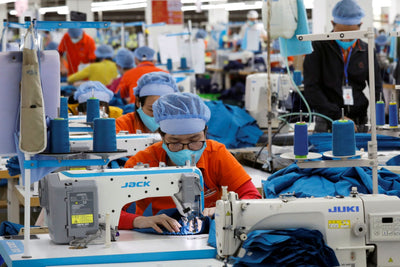
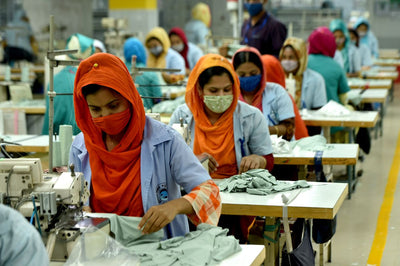
Headwind Manufacturing operates with more than 30 on-site QC inspectors positioned across factories in Asia, running inline inspection (during production) and final random sampling before shipment. That model catches problems at the stage where they’re cheapest to fix. Combined with a 100% replacement guarantee, the risk profile for a German buyer working through that kind of established manufacturer looks meaningfully different from a direct factory order without QC support.
The question isn’t really “global vs local” on quality — it’s whether your OEM partner has the inspection infrastructure to catch problems before they become your problem.
Customisation Flexibility: Global OEM Has the Range
For custom headwear, bags, promotional accessories, and technical apparel, global OEM manufacturers hold a genuine advantage in range of customisation techniques. Domestic German production is often constrained to the equipment a single facility operates. An OEM manufacturer operating across multiple factories in Bangladesh, Vietnam, and China can direct orders to the facility best equipped for a given decoration method — whether that’s sublimation printing on performance fabrics, complex embroidery on structured caps, or injection-moulded hardware on bags.
German promotional product companies, in particular, have discovered that sourcing custom merchandise through OEM manufacturers gives them access to 100+ decoration techniques and fabric combinations that no single European supplier can match. The range on offer from established OEM sourcing partners — covering headwear, bags, apparel, drinkware, and accessories in a single relationship — also simplifies vendor management considerably.
Sustainability: The Uncomfortable Truth for Both Models
Neither model is obviously greener than the other in 2026, and anyone claiming otherwise is probably selling something.
European nearshore production has lower transport emissions and is often subject to stronger labour regulations. Those are real advantages. But European manufacturing still relies heavily on synthetic fabrics produced in Asia, yarns spun in Turkey or India, and dyes processed in facilities that vary widely in environmental standard regardless of geography.
OEM manufacturers in Bangladesh and Vietnam, particularly those supplying major global brands, increasingly operate under GOTS, OEKO-TEX, and Bluesign certifications. Factory-level environmental standards in the best OEM facilities now exceed what many European mid-market manufacturers deliver. The EU’s Corporate Sustainability Reporting Directive (CSRD), which tightened its scope in 2025, pushes German brands toward supply chain transparency — and that requirement applies whether you manufacture in Bielefeld or Dhaka.
What tends to matter more than geography is the audit trail: Does your manufacturer document water usage, chemical inputs, and labour conditions? Can you publish that data to satisfy CSRD and customer expectations? An OEM partner with structured factory auditing capability is, in practice, often more documentable than a small domestic manufacturer with no formal reporting.
Making the Decision for Your Business
The sourcing model that fits your brand depends on three things more than any other: your order volume per SKU, your lead time tolerance, and how much of your brand story depends on a “made in Europe” label.
If you’re running a premium positioning where “Handmade in Germany” is load-bearing for your pricing and customer trust, local production may be worth the premium despite the economics. That’s a legitimate brand strategy, not an irrational one.
But if you’re a German e-commerce brand, retailer, or promotional products company looking to compete on price, scale your range, or deliver custom merchandise at margin — and you have the planning discipline to manage 12-week lead times — then working with an established OEM manufacturer gives you access to cost structures, customisation range, and quality infrastructure that domestic production simply can’t match at equivalent price points.
The brands that run into trouble aren’t the ones who chose OEM production. They’re the ones who chose OEM production without choosing their partner carefully.
Headwind Group has been operating as an OEM manufacturer and sourcing agent since 1980, with direct factory presence across Bangladesh, Vietnam, Myanmar, India, and China. For German buyers looking to evaluate custom headwear, bags, apparel, or accessories from a manufacturer with transparent QC infrastructure and 24-hour quoting, the sourcing conversation starts there.