How to Purchase Custom Fashion Merchandise for Your E-Commerce Store Selling in France
France Is a Strong Market — But the Compliance Layer Is Real
Selling fashion to French consumers through an e-commerce store is a genuinely attractive opportunity. France is the world’s fifth-largest economy, and cross-border online fashion purchases are common: roughly two-thirds of French online shoppers have bought clothing or footwear from abroad. The demand is there. What trips up many US-based e-commerce brands is not the market itself — it’s the paperwork and product requirements sitting between an Asian factory and a French customer’s doorstep.
This guide walks through the full sourcing process: how to commission custom-branded apparel and accessories from Asian OEM manufacturers, what France’s import and EU compliance requirements actually demand, and how to structure your order so that goods arrive correctly labeled, properly classified, and legally sellable.
One clarification worth making upfront: France operates under EU trade law, not its own standalone customs regime. That means the rules that apply in France generally apply across all 27 EU member states — once your goods clear customs at the EU point of entry, they can move freely within the bloc without further customs formalities.
Step 1: Define Your Product and Choose the Right Manufacturing Country
Before contacting any factory, you need to be specific about what you’re sourcing. “Custom fashion merchandise” covers a wide range — branded tote bags, structured caps, hoodies, tees, accessories. Each category has different minimum order quantities, lead times, and compliance touchpoints. Get that list down to a concrete spec sheet: fabric weight, construction method, decoration technique (embroidery, screen print, woven label), colorways, and target retail price.
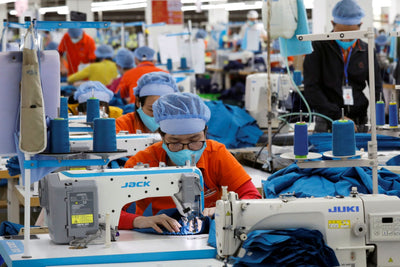
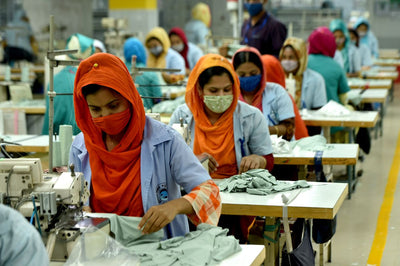
Once you have a spec, the manufacturing country question becomes easier to answer. Bangladesh has moved to the front of the line for apparel — particularly for knit items like t-shirts, hoodies, and sweatshirts — because of its combination of low labor costs and preferential EU trade terms. For structured headwear like baseball caps and beanies, China and Vietnam remain the dominant production hubs, with Vietnam increasingly attractive given its growing factory base and quality-control infrastructure.
The country of origin matters for more than cost. EU customs duty rates on clothing can reach up to 12% on a simple average basis, and the rate applied to your specific product depends on both its HS code classification and the trade agreement (if any) between the EU and the country of manufacture. Getting this wrong at the sourcing stage — choosing a factory in a country with no EU preferential trade access — can add meaningful cost that erodes your margins before you’ve sold a single unit.
For e-commerce brands sourcing custom apparel at scale, working with a manufacturer that already has multi-country production across Bangladesh, Vietnam, and China gives you the flexibility to route specific product categories through whichever origin delivers the best landed cost into France.
Step 2: Commission Samples with EU Labeling Built In from Day One
The single most common mistake in cross-border fashion sourcing is treating compliance labels as an afterthought — something to sort out after samples are approved. In the EU, and in France specifically, textile labeling requirements are mandatory from the moment a product is placed on the market, and non-compliance can result in goods being rejected at customs or removed from sale.
Under EU Regulation 1007/2011, all textile products sold in the EU must carry a permanent label showing fiber composition — for example, 100% Cotton or 65% Polyester / 35% Cotton. The label must be durable, legible, and securely attached to the item (not a removable sticker). Any clothing containing 80% or more textile fibers by weight must display the full fiber breakdown. If you plan to sell in France specifically, the label text must be in French — EU member states are permitted to require their national language on textile labels.
France has also layered on additional requirements beyond the EU baseline. Under the AGEC law (Anti-Waste for a Circular Economy), textile products sold in France must carry sorting and recycling information alongside the Triman logo. France also introduced a textile Eco-Score system that took effect in October 2025 — it assigns an environmental cost score to textile products based on 16 indicators including climate impact, water use, and land use. The law applies to all producers, importers, and distributors placing textile products on the French market, regardless of country of origin. From October 2026, if a brand communicates any environmental score on its e-commerce store, displaying the French Environmental Cost label becomes mandatory.
Build all of this into your sample brief. Ask your manufacturer to produce a compliance-ready label at the sample stage: fiber content in French, care symbols, country of origin, and your brand’s contact information. Fixing a label after bulk production is expensive and sometimes impossible without re-labeling the entire order at a warehouse.
Step 3: Understand the Actual Cost of Getting Goods into France
Import costs into France in 2026 involve several overlapping charges that you need to model before finalizing your pricing.
Customs duty is calculated on the CIF value of goods (cost of goods plus freight plus insurance). EU clothing tariffs average around 12% for non-agricultural products, though the exact rate depends on your product’s HS code and country of origin. Use the EU’s TARIC database or the Access2Markets portal to look up the precise rate before placing your order — not after.
VAT in France runs at a standard rate of 20% for clothing and accessories. It is applied on top of the CIF value plus any customs duty. VAT-registered businesses can reclaim import VAT as input tax, so if you’re operating as a registered business entity in France or the EU, this is a recoverable cost. For direct-to-consumer sales, however, VAT is a real landed cost that affects your pricing.
The EORI number is a registration requirement for businesses importing into the EU. If your business is established outside the EU, you will need an EORI number to submit customs declarations. For B2B shipments, this is non-negotiable; for B2C shipments, the requirement is less strict, but you should confirm with your freight forwarder what documentation is expected.
Low-value parcel levies have changed significantly. France introduced a €2 per-item levy on low-value imports, and the EU has moved to eliminate the de minimis duty exemption for parcels under €150 — replacing it with a flat €3 fee per item as of mid-2026. If your e-commerce model involves shipping individual units directly from Asia to French consumers (DTC dropship), these fees now apply to every parcel and must be factored into your unit economics.
For most fashion brands ordering in bulk and warehousing in the EU before fulfilling to customers, the parcel levies are less relevant — but the customs duty and VAT calculations still apply at the point of entry.
One practical note: France also now bans the use of PFAS (‘forever chemicals’) in textile products as of January 2026, with exemptions for certain protective gear. If your manufacturer uses any PFAS-containing water-repellent treatments or coatings on your garments, you need to confirm this is removed from the production process before goods ship.
Step 4: Vet Your Manufacturer on Quality Control and Documentation
Price per unit from an Asian factory is not the same as landed cost in France. A manufacturer that ships with incomplete documentation, wrong fiber content on labels, or inconsistent construction will cost you far more in customs delays, rejected inventory, or customer returns than you saved on FOB price.
When evaluating OEM manufacturers for the French fashion market, ask specifically about:
- Compliance documentation: Can they provide test reports for REACH chemical compliance? Do they maintain a Restricted Substances List aligned with ZDHC guidelines? EU apparel buyers increasingly require this, and French market surveillance authorities can pull products found to contain restricted substances.
- Labeling capability: Can they produce French-language care and composition labels in-house, or will you need to source these separately and apply them at a third-party warehouse?
- Country of origin documentation: Can they provide a certificate of origin that accurately reflects where the goods were manufactured? This is the document that determines which duty rate applies at EU customs.
- On-site quality inspection: Does the manufacturer have its own QC team, or do you need to hire a third-party inspection service?
Headwind Group, a Hong Kong-based OEM manufacturer with factories in Bangladesh, Vietnam, and China, operates with 30+ on-site quality control inspectors across Asia and offers a 24-hour quote turnaround. Their Bangladesh operation covers full turn-key manufacturing from production through compliance to quality inspection — which matters when you need documentation packages ready for EU customs clearance. Their apparel manufacturing and headwear capabilities are built for brands that need both product quality and the paperwork to back it up.
For US-based e-commerce operators selling into France, working with a manufacturer that already understands export documentation — commercial invoices with accurate HS codes, packing lists, certificates of origin — removes a significant operational burden.
Step 5: Structure Your Logistics and Fulfillment for the French Market
Once goods are manufactured and inspected, you have two main fulfillment models to choose from.
Bulk import to EU warehouse, then domestic fulfillment: You import a full container or LCL shipment to a 3PL in France (or elsewhere in the EU), clear customs once, pay duties and VAT at the point of entry, and then fulfill individual orders domestically. This is the cleaner model for fashion brands with predictable demand — lower per-unit shipping costs, faster delivery times, and no parcel-level customs friction. The downside is inventory risk and the upfront capital required to import in bulk.
Direct-to-consumer from Asia: You ship individual orders from the factory or a nearby fulfillment center directly to French customers. This works for testing demand before committing to bulk inventory, but the economics have gotten harder in 2026. Every parcel is now subject to both the EU’s €3 flat-rate duty fee and France’s additional €2 levy on low-value imports. For a €40 fashion item, those fees alone represent a meaningful margin hit before you account for international shipping rates.
Most e-commerce brands selling fashion to France at any meaningful volume will find the bulk-import model more sustainable. It also lets you offer the fast domestic delivery that French shoppers expect — data suggests that 61% of French online shoppers will abandon their cart if their preferred delivery option is not available at checkout.
For the customs clearance step, working with a licensed customs broker in France is the practical choice. They will handle the Single Administrative Document (SAD), verify your HS code classifications, and ensure your EORI number is correctly referenced on all import documentation. Misclassification of garments is a common and costly error — the difference between a woven jacket and a knitted jacket, for example, can mean a different duty rate.
The French fashion market rewards brands that treat compliance and logistics as part of the product, not as a separate problem to solve after the fact. Get the sourcing structure right, and the market itself is genuinely receptive to international brands selling quality custom merchandise.